The first technical SEO repair should address a meaningful, supported problem. It should not automatically be the warning with the largest count or the most alarming color.
An audit can contain hundreds of instances of one template defect, alongside a single failure on the page customers need most. Good triage connects each finding to its purpose, checks whether it is real, and groups the work into something a person can fix.
Begin with important public pages and customer journeys. Then move through availability, intended search eligibility, discovery and experience. This order is a working method, not a universal ranking formula.
1. Check whether people can complete the task
Load representative affected pages anonymously and repeat the important journey. A page can return a successful response while showing empty content or failing when someone submits a form.
HTTP status codes are useful evidence, but they describe a protocol response rather than every aspect of application success. MDN's reference explains the status families.
Demonstration: a fictional business has many optional markup warnings and one booking endpoint that repeatedly fails. The booking failure deserves immediate investigation because the task is both important and reproducibly unavailable. Fixing optional markup first would leave the more consequential failure untouched.
Record the exact conditions. A particular crawler being blocked is different from all visitors being unable to access the page. Do not weaken a security control merely to make an audit look clean.
2. Confirm that exclusion is actually unintended
Some pages should stay out of search: private account screens, staging copies or other deliberately excluded material. An audit flag is meaningful only when it conflicts with the page's intended role.
For a useful public page, inspect response headers, source and relevant rendered directives. Check recent template changes and search-engine inspection evidence where available. An unexpected exclusion on an important page warrants a precise investigation.
Keep crawl instructions and indexing controls distinct. Google explains that a URL disallowed in robots.txt can still be indexed through other signals. Its robots.txt guidance also makes clear why this file should not be treated as access security.
The repair must match the goal. “Remove every restriction” is not a safe or useful audit recommendation.
3. Investigate canonical signals in context
Canonical declarations help communicate a preferred URL among duplicates. They are not a general way to make several different pages behave like one.
Inspect the declared destination. Does it load? Is it intended to be eligible? Does it represent the same content? Are redirects, internal links and sitemap references pointing in conflicting directions?
Google's canonicalization documentation describes different methods and their limitations. A declaration is a preference signal; the engine still makes its own selection.
Before recommending consolidation, verify the duplicate relationship and preserve useful distinct tasks. A buying guide and a booking page can share terms without being interchangeable. The content-investment guide explains why overlap alone is insufficient.
4. Check discovery and rendering separately
A page in the content system may be absent from normal navigation. A link visible after an interaction may behave differently from a crawlable link. A partial crawl may also miss a perfectly valid path.
Compare the crawl with other authorized inventory sources before declaring a page orphaned. For important public pages, inspect contextual links and their destinations. Google recommends that pages you care about have internal links; its link guidance supports a practical discovery check, not indiscriminate link insertion.
For JavaScript-dependent pages, distinguish fetching, rendering and indexing. Google documents these as separate stages in its JavaScript SEO guidance. JavaScript itself is not a defect. Missing essential content or inaccessible resources in a relevant crawler view provide a stronger reason to investigate.
Verify representative templates rather than assuming that one browser success proves every page works for every relevant client.
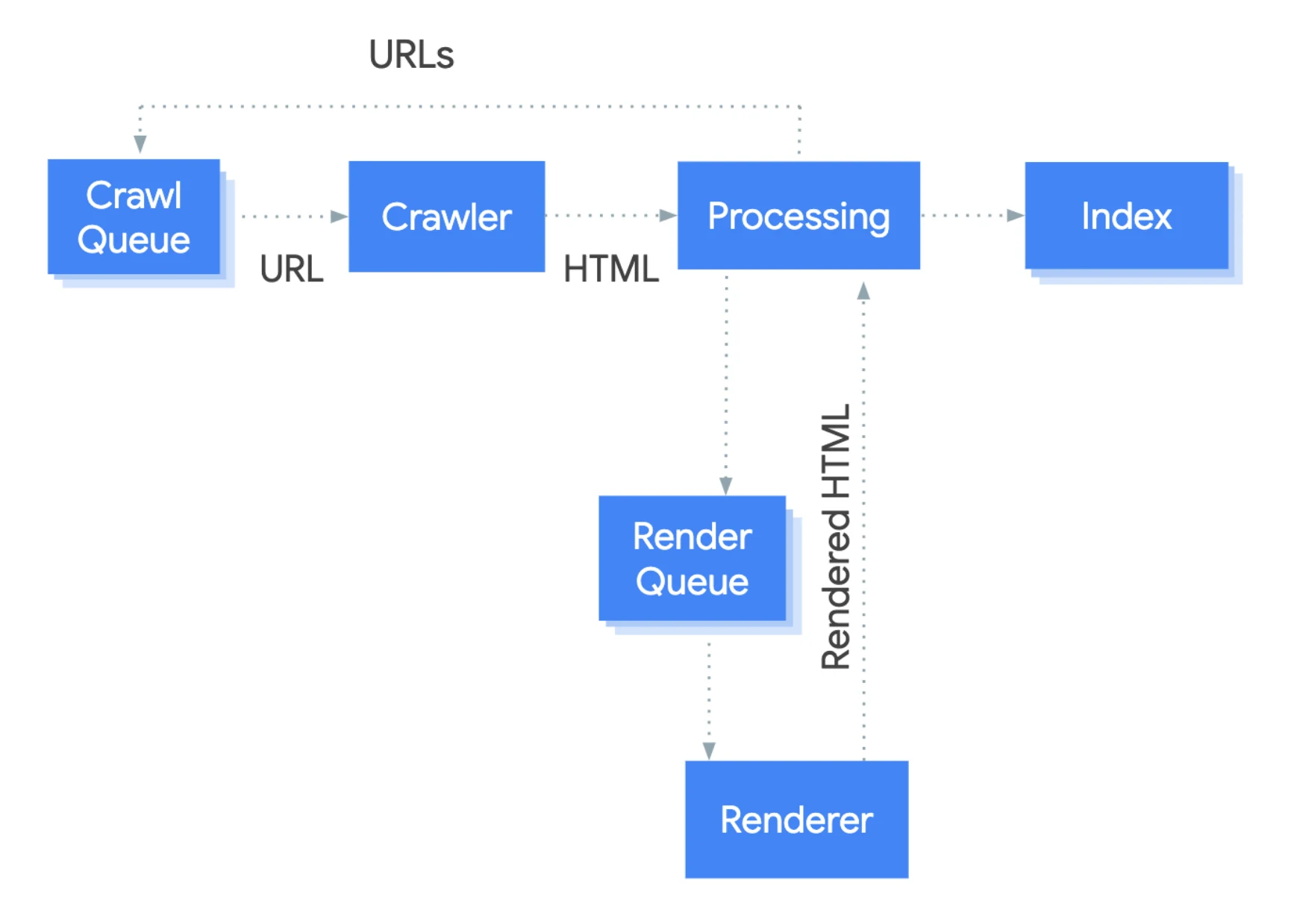
Google Search Central · CC BY 4.0 · License
5. Prioritize the experience visitors actually receive
Performance work should consider the affected audience and task. A slow experience on an important mobile journey can deserve more attention than a marginal score change on an unused page.
Core Web Vitals currently use LCP, INP and CLS to describe important aspects of experience. web.dev's definitions assess recommended boundaries at the 75th percentile, with device segmentation. The thresholds do not predict a fixed revenue increase.
Use field evidence to understand experienced performance and diagnostic tools to investigate a reproducible cause. Keep the population and period visible. Missing field data is unknown, not a perfect score. An origin-wide aggregate is not automatically the experience of one specific landing page.
After a change, verify the technical behavior and allow enough new field observations for a meaningful comparison. Check functional and visual regressions too.
6. Keep enhancements proportional to their evidence
Structured data can improve eligibility for relevant search features, but valid markup does not establish an outcome. Google's guidance says “it does not guarantee that it will be present” when discussing feature appearance. Read the structured-data policies.
Correct misleading or invalid markup when it applies. Keep optional enhancements in proportion to verified access and task failures. Do not invent ratings, credentials or other facts to satisfy a schema template.
Likewise, a submission acknowledgement is not proof of search inclusion. IndexNow's FAQ explains that participating engines decide crawling and indexing. Record the completed step accurately: submitted, fetched, eligible or observed in search. Those states answer different questions.
7. Turn the audit into a bounded repair
Group findings by underlying issue, affected template and responsible owner. A task should identify the target, observed failure, proposed change, scope and verification steps. Keep supporting instances available without making the operator triage each one independently.
Verify the deployed behavior after repair. Then schedule a later check for the search or business outcome the work was meant to support. The first can be conclusive while the second remains uncertain.
Use website prioritization to compare technical repairs with other work, and outcome measurement to plan the review. A useful audit leaves the team with justified, finishable tasks and a record of what each repair established.
Source references
Accessed 10 November 2026. Citations support the adjacent claims; they do not validate an individual site diagnosis or imply endorsement of SignalDesk.
- HTTP response status codesMDN Web Docs
- Introduction to robots.txtGoogle
- How to specify a canonical URLGoogle
- Understand JavaScript SEO basicsGoogle
- General structured data guidelinesGoogle
- SEO link best practicesGoogle
- Web Vitalsweb.dev / Google
- IndexNow FAQIndexNow
Make the decision reviewable.
See an example with its observation, next action, six checks and follow-up kept together.
Read the example