Choose the page that best serves the reader's task before choosing whether to publish something new. Sometimes the right investment is a substantial update. Sometimes a new audience or decision needs its own page. Sometimes neither will fix the problem.
This matters when editorial time is limited. A monthly publishing target can encourage a team to create a second answer while the useful first answer grows inaccurate. A refresh target can produce the opposite waste: repeatedly polishing a page that addresses the wrong task.
Use the decision process below to make the tradeoff explicit.
1. Describe the reader's task in one sentence
A topic is too broad to guide the decision. “Appointment software” might include learning what the software does, comparing options, understanding pricing, or fixing a calendar connection.
Each task may need different evidence and a different next step. An educational guide cannot automatically replace a pricing page because both mention the same software.
Write a sentence such as: “Help an independent clinic owner compare scheduling options for a two-person team.” Then identify what that reader needs to decide: constraints, costs, implementation effort and examples they can understand.
Search results can help reveal expected content type, format and angle. Ahrefs describes those considerations in its search-intent guide. Treat the pattern as evidence to consider alongside customer questions, rather than instructions to imitate the current winners.
2. Find the page that already serves that task
Search the site's content inventory, not just its article archive. A service page, FAQ, documentation page or comparison page may already contain the right answer.
Read the page itself. Record its purpose, audience, useful evidence and next step. Then compare the proposed work with that purpose. If the task is the same, ask what a new URL would add that the existing page cannot sensibly provide.
Demonstration: a fictional clinic software company proposes a new article about setup time. Its existing implementation guide already answers the same question, but the instructions reflect an old onboarding process. Updating the guide with current steps and a clear example would address the gap directly.
That is a reason to refresh. It is not proof that refreshing will increase traffic by a particular amount.
3. Establish what is wrong before calling it decay
An old publication date is not a defect. A page can remain accurate and useful for years. A recently published page can already contain an important error.
Look for specific problems: obsolete instructions, unsupported claims, missing decisions, broken examples or a changed product. A fall in search performance can also justify investigation, but it does not automatically establish an editorial cause.
If traffic is the trigger, first diagnose the search decline. Access failures, changing demand and a different result experience call for different actions. Updating paragraphs cannot repair an unintended indexing exclusion.
Ahrefs' republishing workflow emphasizes choosing worthwhile updates and adding substance. The useful principle is to document what the reader gains. Changing a date without improving the answer cannot supply that missing value.
4. Check overlap without assuming harm
Two pages can appear for the same query and still serve distinct purposes. One might explain how to choose a service; another might let someone buy it. Shared vocabulary is expected.
Ahrefs advises readers to “check the SERP and ranking history” when assessing suspected cannibalization. Its examples and cautions are especially useful because they show why an overlap warning needs judgment.
Before consolidating, inspect the pages' other queries, links, conversions and support roles. A low-traffic page may answer a question sales staff send to nearly every serious prospect. A second page may attract a different long-tail audience that a combined page would serve poorly.
Consolidation should solve demonstrated duplication. It needs a useful destination, a link and redirect plan where appropriate, and a way to watch for lost value. A canonical tag is not a general instruction to make two different answers behave like one.
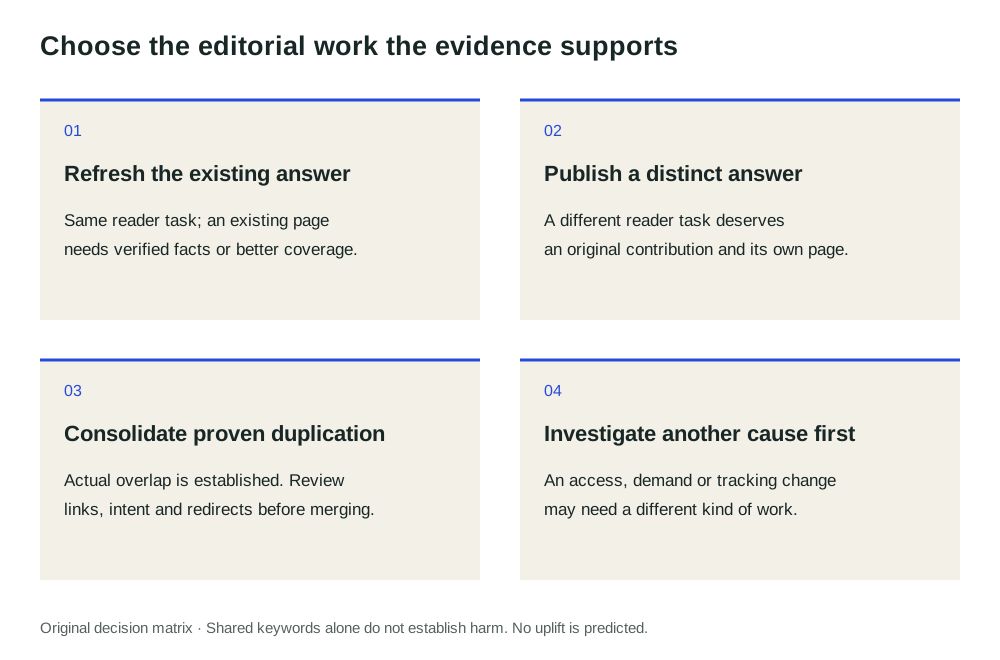
5. Choose one of four editorial decisions
Refresh the existing page when the task remains appropriate and a specific gap can be fixed there. Preserve the useful material, improve the weak part, and make the change understandable to the editor.
Create a new page when the audience or task is meaningfully distinct and the business can contribute something worthwhile. State how it differs from nearby pages and where readers should encounter it.
Consolidate when multiple pages duplicate the same task and there is evidence that a single maintained destination would serve readers better. Preserve valuable information and review the consequences of retiring each URL.
Investigate or defer when the evidence points elsewhere or the proposed article has no clear contribution. Editorial capacity is valuable. Keeping it available for a better-supported task is a real decision.
These alternatives should appear in the brief. They help a reviewer understand why the selected work deserves the time it will take.
6. Require an original contribution
Before drafting, name what the business can add: a worked example, tested instructions, product detail, original analysis, a useful comparison or an explanation drawn from real support questions.
Google's people-first content guidance asks publishers to consider usefulness and original value. It does not supply a numerical content score that guarantees rankings.
Nor should an external traffic estimate decide a page's entire value. Ahrefs' widely quoted 2023 traffic study explicitly describes index and estimation limits. A reported zero is not proof that no visitor arrived or that the page serves no business purpose.
The brief should identify the audience, task, existing coverage, original contribution, source material, intended next step and owner. Keep claims verifiable. A competitor's confident assertion does not become evidence because several articles repeat it.
7. Define success before approving the work
Start with editorial verification. Did the revised instructions work? Does the page answer the stated question? Do its references support its claims? Are its links and next steps useful?
Then define the later outcome check. A comparison page might aim to support qualified enquiries. A help page might aim to reduce a recurring support problem. Search clicks may be relevant, but they need not be the only measure.
Record other changes that could affect the result. A successful refresh can coincide with weaker seasonal demand; rising traffic can follow a campaign rather than the edit. Closing the loop means reporting those limits alongside the outcome.
The practical deliverable is a reasoned editorial investment. It tells the writer what to improve, tells the reviewer why that work matters, and gives the team a later question it can actually answer.
Source references
Accessed 10 November 2026. Citations support the adjacent claims; they do not validate an individual site diagnosis or imply endorsement of SignalDesk.
Make the decision reviewable.
See an example with its observation, next action, six checks and follow-up kept together.
Read the example