Make the next piece
of work clear.
Evidence enters with its limits. A person reviews the decision. The work leaves with an owner and a way to check it.
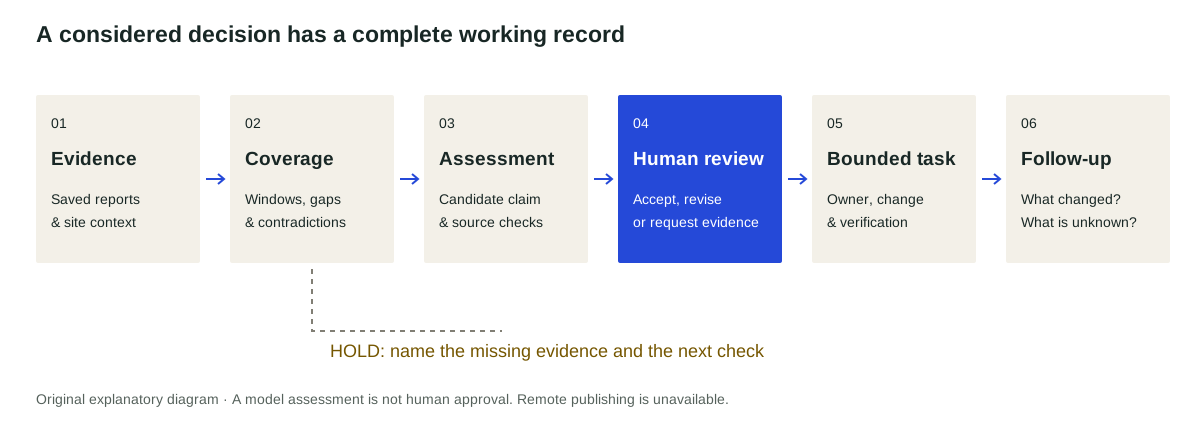
An explanatory workflow diagram. It does not represent live connector activity or automated publishing.
Saved reports and site context, with their original dates and limits.
Look for missing coverage, conflicting facts and duplicate work.
Accept, revise, reject or ask for the evidence that would change your mind.
An owner, an exact next action and a check to return to.
Not enough evidence? Hold the recommendation. Name the next check.
One finding.
A complete working record.
Take the illustrative mobile form example. A broken customer task is a reason to investigate. It is not permission to invent lost revenue.
Read the exampleA phone-width check shows the submit control covered by a fixed footer. Record the affected task and the reproduction limits.
The obstacle is visible. How many enquiries it affected is unknown. A reviewer can request more evidence or narrow the task.
Reproduce the issue, change the relevant layout, retain a rollback and confirm an enquiry arrives. The website change happens outside SignalDesk.
Record that the repair works. Review later enquiry observations separately. “Business outcome unknown” remains a valid result.
Bring your next decision
to the desk.
See how a finding becomes a bounded task, with a person responsible and a way to check it.
Read the exampleAlready have pilot access? Sign in ↗