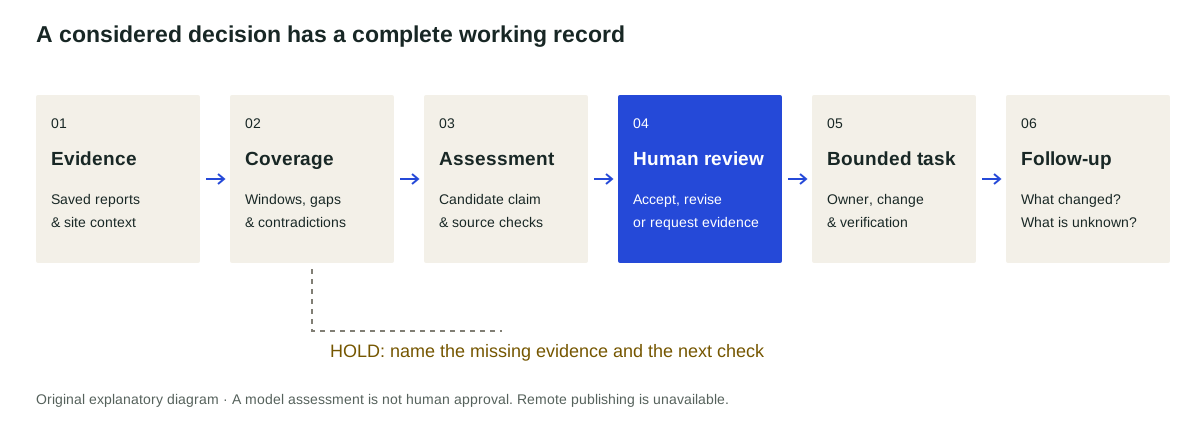
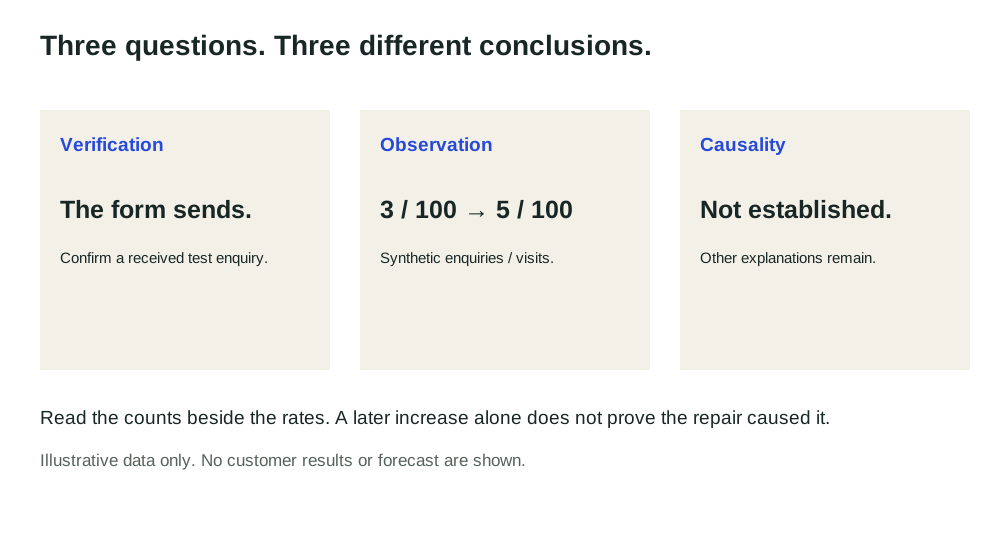
Plan the outcome check before making the website change. Decide what should work immediately, what you will observe later, and what evidence would justify a claim that the change caused an improvement.
Those are three different questions. Keeping them separate makes client reporting more useful and helps the team choose its next action. A repair can succeed without a measurable commercial effect. A metric can improve even when the proposed explanation is wrong.
The goal is a record that helps someone decide what to do next, rather than a chart that makes every completed task look successful.
1. Write down the action and its reason
Begin with the decision that led to the work. Which customer task was affected? What evidence supported the action? What uncertainty remained?
Record the exact page or component, proposed change, owner and approval scope. A broad task such as “improve conversion” will be difficult to verify. “Retain the enquiry message when telephone validation fails” is something the team can test.
Keep the original evidence and baseline. Otherwise, the next reviewer may have only a recollection of the problem and a screenshot of the revised page.
This can be a short record in the tool the team already uses. A complicated reporting system is unnecessary if nobody maintains the underlying action history.
2. Choose an outcome that matches the task
Use a measure close enough to the intended benefit to matter. A form repair might be verified through accepted and delivered submissions. Its later business check could examine qualified enquiries, with spam or duplicates as guardrails.
A content update might aim to answer a specific question accurately and support an appropriate next step. Search clicks can be relevant, but they should not silently replace that purpose.
Record numerator and denominator for rates. Three accepted submissions among one hundred eligible visits communicates more than “a three percent conversion rate” without context. Define which visits count and keep the definition stable.
The conversion research guide explains how to choose and investigate the task before proposing a change.
3. Verify that the change actually happened
Inspect the deployed result, not just the edited file or task status. Repeat the original failure conditions and test nearby paths that could have regressed.
For a form, check recovery, submission, confirmation and delivery with appropriate test data. For a content correction, verify the factual answer and links. For a technical change, inspect the relevant live response or rendered behavior.
Demonstration: a fictional business repairs a mobile form that discarded messages after a validation error. A test now preserves the message and delivers a valid submission. That establishes the repair's behavior under the tested conditions.
It does not establish how many real enquiries the business would otherwise have missed. Verification should be recorded as a useful success without attaching an invented revenue amount.
4. Schedule a later review that allows uncertainty
The right review window depends on what needs to change and how much evidence the site receives. An immediate functional check differs from waiting for recrawling or enough eligible customer visits.
Set a review date and explain what evidence should be available by then. If the expected sample has not arrived, update the record instead of manufacturing a conclusion.
Useful outcomes include improved, worse, no clear change and insufficient evidence. Add context: demand shifted, another campaign launched, the tracker changed, or the observation window remains too small.
This is particularly important after content refreshes and search-decline investigations, where external demand and search changes can affect the same period.
5. Distinguish observation from causality
Demonstration: a fictional page moves from three submissions in one hundred eligible visits to five in the next hundred. The counts describe what was observed. They do not, by themselves, establish that the edit increased submissions.
The visitors may differ. Demand may have changed. A campaign may have brought a more suitable audience. With rare events, ordinary variation also deserves attention.
Microsoft Research's metric-interpretation work documents why metric movements can support incorrect conclusions. Even an experiment needs trustworthy measurements and interpretation.
Use accurate language: “The repair passed verification; submissions were higher in the following period; the contribution of the repair is not isolated.” That gives the reader useful evidence without pretending the uncertainty is gone.
6. Use an experiment when it can answer the decision
For a choice between working alternatives, an appropriate experiment can provide stronger evidence. Plan the eligible population, assignment, primary outcome, guardrails, sample requirements and analysis approach before launch.
Check whether the site can support the question. A small business may wait a long time to distinguish modest differences in rare outcomes. A focused usability study or a verified repair can answer a different, useful question sooner.
NN/G's small usability-study guidance concerns qualitative learning; it is not a rule for powering conversion experiments.
Check assignment integrity as well as outcome metrics. Microsoft's sample-ratio mismatch research explains how unexpected group proportions can signal a defect. An attractive result should not bypass that investigation.
7. Evaluate AI assistance against the same standard
If AI prepares recommendations or reviews results, preserve the evidence it used and the claims it made. A fluent explanation with citations can still misapply the evidence.
Ragas research separates retrieval and faithfulness from other answer-quality questions. Research on model judges identifies biases that can affect their preferences. Neither a citation nor a second model's agreement is human approval.
Anthropic's evaluation guidance lists “Requires calibration with human graders for accuracy” among model-grader limitations. Its 2026 evaluation article supports combining different checks. Record real reviewer decisions as real reviewer decisions, including corrections and disagreements.
8. Use the record to choose the next action
At review, decide whether to retain, revise, reverse or investigate further. Preserve unsuccessful and inconclusive outcomes alongside wins. They can prevent the next person from repeating an attractive idea that already failed under similar conditions.
The resulting report can stay short: what changed, what passed verification, what happened afterward, what remains uncertain, and what follows.
That is the practical value of closing the loop. It turns completed work into usable context for the next website priority, while giving the client a clear account of what the team actually established.
Source references
Accessed 10 November 2026. Citations support the adjacent claims; they do not validate an individual site diagnosis or imply endorsement of SignalDesk.
- A Dirty Dozen: Twelve Common Metric Interpretation Pitfalls in Online Controlled ExperimentsMicrosoft Research / KDD
- Diagnosing Sample Ratio Mismatch in Online Controlled ExperimentsMicrosoft Research / KDD
- How Many Test Users in a Usability Study?Nielsen Norman Group
- Demystifying evals for AI agentsAnthropic
- Judging LLM-as-a-Judge with MT-Bench and Chatbot ArenaarXiv / research authors
- Ragas: Automated Evaluation of Retrieval Augmented GenerationarXiv / research authors
Make the decision reviewable.
See an example with its observation, next action, six checks and follow-up kept together.
Read the example